Showing posts with label Toi Toy. Show all posts

Friday, August 24, 2018

36 Victors in the Land of His Forefathers


Kellar, Winkler, and Derrick, bronze star recipients


The Allies now entered Germany, pushing eastward after the Battle of the Bulge. Jack’s unit was on the move. 

From there it was a push on through France and into Holland, into Luxembourg, into Belgium, and from Belgium into Germany. As quickly as the army would take an airfield and secure it, we would move in. In one twelve-month period, we were on thirteen different bases. So by the time you set up camp and one thing ‘n’ another on base, you were ready to move again.[1]

Brunswick (top) and Wiesbaden (below) from "Fritz," a Group artist's
cartoon map of the 363rd's movements in Europe, 1943-1945
 Jack's grandfathers both immigrated to the U.S. from German principalities as children, and they both married women of German descent. They settled in a Pennsylvania German community with others like themselves. Jack’s parents migrated across the U.S. to California, integrating with a broader mix of ethnic traditions. While the children of Jack’s generation were aware of their German heritage, it had lost much of the immediacy and power it had held for his grandparents.

In Germany Jack trod the same ground his forbears had labored and left. He knew little about them and their heritage, much less about extended family living in Germany. He probably had cousins who served in Hitler's army. Because the Germans looked so much like the folks at home, American soldiers were warned not to trust and associate with them.

April 5, 1945, 3 years today!!!
Dearest Alice,
I have a non-fraternization plan all of my own & the only woman I can have anything to do with is you.[2]

The month after Jack wrote on his third wedding anniversary, German armed forces surrendered unconditionally. The 363rd took over established German airbases.

Main building of the Braunschweig (Brunswig) airbase

Metler, Judge, Toy, and three other crewmen

The war ended in May, and we were in Brunswig [Braunschweig], Germany, sixty kilometers from Berlin. At Brunswig German planes, all kinds of planes, had been coming in for several days before the war was over with their wheels and flaps down, surrendering. I felt sorry for some of the soldiers and people who got off the planes. They had their bicycles, pets, and belongings with them. They were going to go home because they lived near Brunswick, but no, they were taken as prisoners of war right there. The war was not yet over with.[3]


Jack's view of the German pilots

Germany, May 8, 1945
Dearest Alice,
We have had several Jerry [German] airplanes come in an[d] surrender here and it’s pretty exciting. It was really a beautiful day here today. It seemed like God made it beautiful just because the war was over.[4]


From the periphery, Jack captured the moment of some
Germans' arrival and capture.
The war’s end meant Jack was finally free to write what he wanted.
!Uncensored!
Germany, May 22, 1945
Dearest Alice,
Well some of the boys have some champagne here tonight so things are pretty lively around here Ha. I’ve had my share for a while tho Ha. Yes they finally took censorship off of our letters so now we can say what we please. What a relief not to have some stooge reading your letters all the time.[5]

The Americans were victors, allowing Jack to be a cautious tourist. He loved seeing the country, wherever he was.

When the war was over we moved several times and spent some time down near Wiesbaden. That was an established base, but it was blown up. Everything was blown up around there; everything was destroyed. We had turned in our vehicles and our planes and didn’t have an awful lot to do. Several of us confiscated some German vehicles that were free to anybody who wanted them. That’s where I had the German jeep. We painted them up with army olive drab and put fake serial numbers on them and big stars. We were issued trip tickets to go off the base and really saw a lot of the country over there. We had plenty of gas on the base where we were stationed, and we could go wherever we wanted. 

Red Pelizzari and Jack's German jeep
Beyond the devastation there were hills and forests to explore.
 One night we got way back in the hills and came to a farm. We told the German we wanted to buy some eggs, but he couldn’t understand. Soon I cackled like a chicken and showed him where the eggs came from, and we went home with eggs.

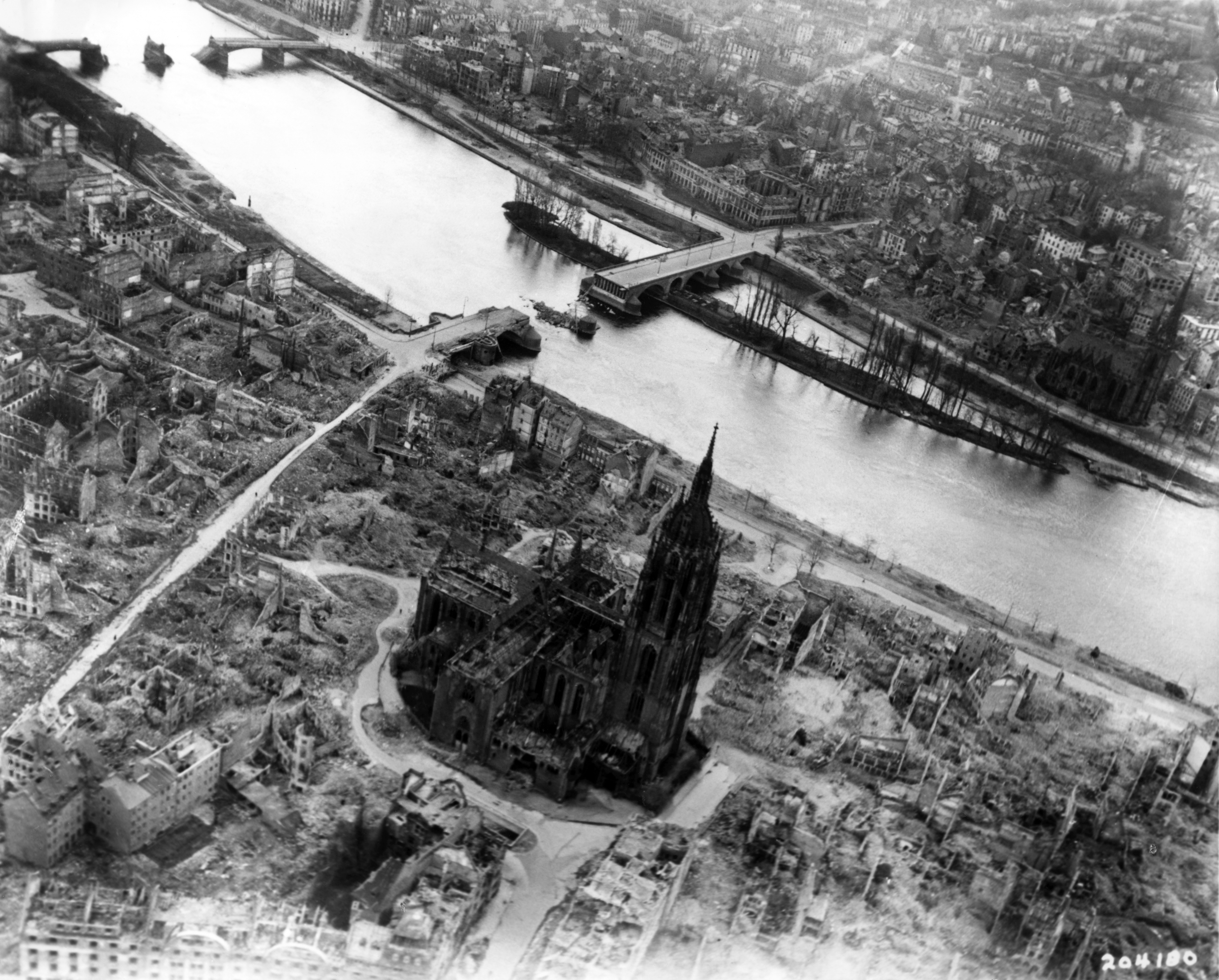
Since our vehicles had been turned in, the only transportation was these jeeps, so when one of the officers said he wanted to go someplace, I said, “I’ll have to drive,” so we saw lots of country. It was also my duty to go into Frankfurt each day and pick up the barber and take him home at night. Also to make a beer stop in Frankfurt at the brewery and bring back beer for the fellas.[6]

Frankfurt, 1945[7]
What Jack saw in Frankfurt, young boys cleaning the rubble
The trio from Sonoma County, California, received bronze stars for keeping their planes flying. Jack’s award letter reads,
Dear S Sgt Kellar,
            It is with extreme pleasure that I offer my most hearty congratulations to you for performing your job in such a superior manner. It is recognized that such a magnificent record of 42 consecutive missions, established by the aircraft assigned to you, could never have been possible without the superior maintenance provided by you as crew chief.[8]

Jack's good conduct medal and bronze star

As the war was over, and spring turned to summer, the boys were ready to go home. That was more easily imagined than done.


[1] Jack J. Kellar, interview about his first years after high school by Judy Kellar Fox, 12 April 1993; cassette tape recording and transcription held by the author. Lightly edited excerpt.
[2] Jack J. Kellar (Germany), letter to “Dearest Alice” [Alice (Streeter) Kellar] (Santa Rosa, California), 5 April 1945, excerpt.
[3] Jack J. Kellar, interview, 12 April 1993. Lightly edited excerpt.
[4] Jack J. Kellar, letter to “Dearest Alice,” 8 May 1945, excerpt.
[5] Jack J. Kellar, letter to “Dearest Alice,” 22 May 1945, excerpt.
[6] Jack J. Kellar, “Autobiography,” 1998; two ninety-minute cassette tape recordings; held and partially transcribed by the author. Also, Jack J. Kellar, interview, 12 April 1993. Lightly edited excerpts.
[7] “Frankfurt on the Main,” photograph, 31 March 1945, U.S. Air Force photographer (https://upload.wikimedia.org/wikipedia/commons/5/5b/Frankfurt_Am_Main-Altstadt-Zerstoerung-Luftbild_1944.jpg : accessed 22 August 2018), public domain; image quality improvement by Mylius [link https://commons.wikimedia.org/wiki/User:Mylius ] 2010.
[8] James B. Tipton, Colonel, Air Corps, Commanding (APO, New York City, New York), letter to S Sgt Jack J. Kellar (APO New York City, New York), 12 August 1944.

Friday, June 29, 2018

28 Following the Liberators through France


G.I. Tourists in Paris
Jack at the Palais de Chaillot looking toward the Eiffel Tower
Jack’s group followed the front lines pushing back against the Germans. Paris had been liberated by the French Resistance in August 1944 and Allied troops soon followed, officially and on pass. Jack photographed the famous Champs Élysées Boulevard where German troops had proudly asserted their authority over the French capital in 1940 and General Charles De Gaulle had strolled after liberating the city. By the time Jack arrived, the city looked almost itself again.
“General de Gaulle and his entourage proudly stroll down the
Champs Élysées to Notre Dame Cathedral . . . 25 August 1944”[1]
The Champs Élysées as Jack saw it
Winkler at the Palais de Chaillot
Jack with the Eiffel Tower and the Palais
de Chaillot in the distance


Indulging in one of the things they
missed most from home: ice cream

The Push through France
Now that he was moving through Europe, Jack was able to tell Alice where he had been in England and France over the previous ten months. It was a secret no more.

Keevil > Rivenhall > Stapleton > Maupertus > Montebourg > La Bazoge > Saint-Dizier > Luxembourg[2]

Europe, Oct 17, 1944
Dearest Alice,
  Well honey I suppose you have wondered many times where we have been since coming overseas. We landed in Scotland & took a train to England & went to a place called Keevil. It’s very small & probably not on the map but it’s near Trowbridge which is near Bath. From here we went to Rivenhall. That’s near Witham which is near Chelmsford. From here we went to Staplehurst which is near Maidstone. From there over to France & I arrived just outside Cherburg on July 4 where we were stationed for some time. From there we went to a place near Monteb[o]urg. From there to La Boyoge [La Bazoge], just outside of Le Mans. Then when Derrick & 4 other fellows & I were away on Detached Service we were at Saint-Dizier. From there we left France and are at our present base. I’m sure glad you got the bracelets & I’m glad you like them. They aren’t much but they are a souvenir of France. I got them at St. Pierre-Eglise [near Cherbourg].
  I don’t know what kind of fish they have in France but the ones we caught were just big enough to throw back in.[3]

On Detached Service at Saint-Dizier, France

A sign on the door of the restaurant of the Hôtel de l’Univers takes
clear aim at Allied soldiers. It reads in English, “Off Limits.”
Signs on the Saint-Dizier theater read, “Honor to our liberators” and
“Long live the Republic.”
Opposite the Saint-Dizier theater on the main square sits the town hall with a sign reading,
“Long live de Gaulle.” It honors the leader of the French Resistance who would later become
President of the French Republic. 

Living Quarters as the Group Moved from Base to Base
Jack explained to his grandchildren about the living quarters during his time in the ETO: A tent holds six soldiers or beds. There wasn’t room enough for a bathroom in the tent. The bathrooms didn’t have roofs on them. (Some of them did.) And they got wet.[4]

Morning at the tents

Constructing a latrine: Toy, Judge, Metler and two loafers
Finished latrine with Judge and Metler

Perspective on the tent situation by a member of the 160th[5]

 
In fact, only the staff sergeants slept six to a tent. Some grades had fewer men per tent, but most of the men were crowded together. There were stoves for warming, but the stoves had been left in Cherbourg and were not replaced. As the weather turned with the seasons, the men would happily have had the stoves. Jacked mentioned the situation to Alice.

We are still having rain & cloudy & cold weather so there isn’t much to do [i.e., the planes could not fly]. We have no stove in our tent & it sure gets damp & cold in there. I sure hope they get some stoves soon.[6]


All planes flew manually, so rain and overcast skies grounded them, leaving the ground crews with time on their hands. Excitement was on the horizon, however, with the unexpected arrival of an enemy plane.


[1] “General de Gaulle and his entourage proudly stroll down the Champs Élysées to Notre Dame Cathedral for a Te Deum ceremony following the city's liberation on 25 August 1944,” photograph, Imperial War Museum, Ministry of Information, Second World War Press Agency Print Collection (http://www.iwm.org.uk/collections/item/object/205015974), photograph HU 66477, public domain; as reproduced in Wikimedia (https://commons.wikimedia.org/w/index.php?curid=19139629 : accessed 29 June 2018).
[2] “The Push through France,” map created with Google Maps (https://www.google.com/maps : accessed 28 June 2018).
[3] Jack J. Kellar (Luxembourg) letter to “Dearest Alice” [Alice (Streeter) Kellar] (Santa Rosa, California), 17 October 1944, excerpts.
[4] Jack J. Kellar, interview by Judy Kellar Fox, December 1993; cassette tape recording and transcription held by the author.
[5] Ralph C. Fritz, illustrated map of the 160th Squadron in the ETO, 15 August 1945, detail; “Life with the 160 Tactical Reconnaissance Squadron,” collection of eleven photographs, U.S. Army Air Force, 1944–1945.
[6] Jack J. Kellar letter to “Dearest Alice,” 17 October 1944, excerpt.