|
| A relaxed photo that gives no hint of anxiety |
Jack’s base at
Staplehurst lay some hundred kilometers across the Channel from Calais, France,
on a direct path for German fliers targeting London.
Ground crews rarely saw enemy action, but they had to
be prepared. They dug trenches, and they trained in marksmanship. Mostly they
worked, nonstop, to keep their planes flying. They even used their ingenuity to
arrange to sleep right down on the line where they were working. So totally
focused on the job at hand, they were unprepared for danger when it actually
appeared.
Belly Tank Beds on the Line
The
belly [gasoline] tanks were shipped to us in plywood containers about six and a
half feet long and two feet wide. We were working long hours, and some of us
crew chiefs decided instead of going up to the tent area to sleep, we would put
our mummy bags (a bag filled with straw to act as a mattress) in the belly tank
boxes and sleep on the line. We turned the opening of the belly tank box away
from where the planes would turn and possibly throw dust and dirt on our sacks.
Even so, we still got dirt, rocks, and dust on our beds. We also had our rifles
in the box.[1]
 |
| P-51s at the ready |
 |
| Kellar, Derrick, and Winkler |
 |
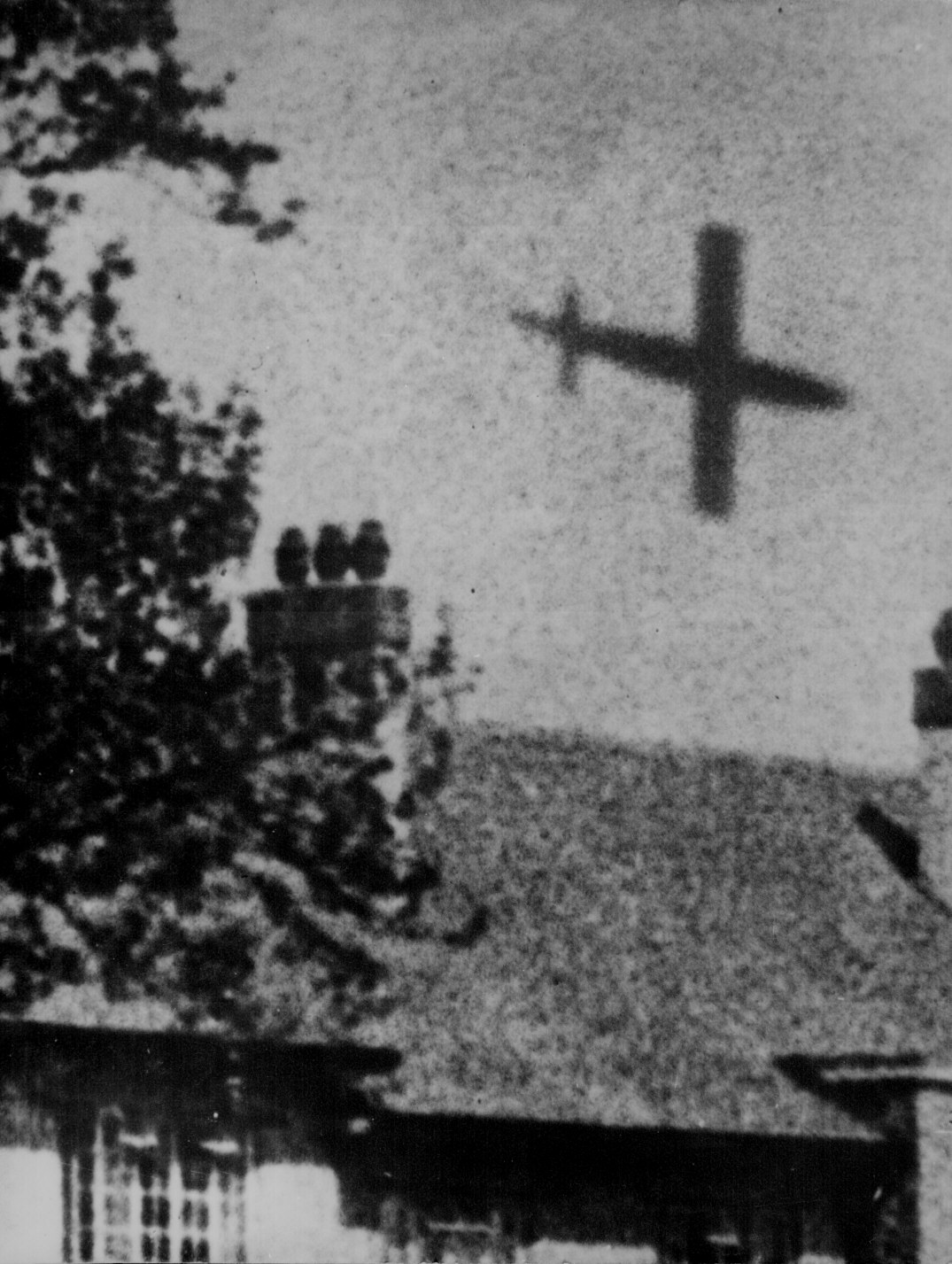
| A "plane on fire" over rooftops in England[2] |
An Interrupted Midnight Dinner
A mess sergeant brought some food to us down on the
line about midnight. As we continued to work on our planes, we heard an awful,
loud drone. We went outside the engineering tent, and here was a plane at
treetop level with flames shooting out of its tail. We thought at
first when it came over that there was a plane on fire because of the big ball
of flame that came out of the tail end of this thing. So naturally we thought,
well, they must be enemies, and we’d go out and start firing the rifles. Only the
rifles wouldn’t work because they’d been laying in the box, cleaned, in the belly
boxes, with the planes swinging around, throwing all the dust and everything
into there, and the rifles wouldn’t work. Nobody’s rifles would work.
It
was a very, very confusing night. After the planes on fire started coming over
two or three or four at a time, it was announced over the loud speaker system,
“It’s been reported,” I’ll never forget this, “that enemy paratroopers have
landed in our area. Do what you think best.” Oh boy, now what do we do?
 |
| V-1 in pre-launch[3] |
Colonel
Cloke, who was commanding officer of our group [363rd] of three
squadrons, came down on the line, and somebody challenged him. We didn’t know
who he was. It was dark, and with the threat of enemy paratroopers, a guard
challenged him. Colonel Cloke had been drinking that night, and what went on
wasn’t a very pleasant scene. No one was court martialed for what was said
because what did we know who it was?
 |
| Lt. Col. Marshall Cloke[4] |
There were no paratroopers, and we
found out these planes on fire were V-1 rockets called buzz bombs, pilotless
airplanes with bombs on them. They started coming over daily, during the day or
during the night. They were headed for London, the biggest part of them, but
the engines could cut out at any particular time, which means that the thing
fell, and the bombs went off. We started sending planes up after them. We sent
one plane up, and it burnt its engine up right away trying to chase it, because
it was going so fast. So they discontinued sending our planes up, and the AK-AK
(artillery) went after them. They would shoot some down, but the biggest
part of them got through. But at that time they had put up balloons with big
cables on them to protect London. In other words, before the V-1s got to London
they would hit the cables, and then they would go down and explode there rather
than going on into London.
 |
| Barrage balloons over London, with Parliament in foreground[5] |
That night was
13 June 1944, the first launch of the V-1 against London and a week after
D-Day. While the invasion of France lives on as a major historical event, to
Jack the real excitement of the month was the first experience of the V-1. The
build-up to invasion turned out to be a letdown for the 363rd.
To hear the V-1 as Jack heard it, click here (YouTube: “World War Two Live (Original) V1 Rocket Sound Recording”).
[1] Jack J. Kellar, “Autobiography,” 1998; two
ninety-minute cassette tape recordings; held and partially transcribed by the
author. Also, Jack J. Kellar, interview about his first years after high school
by Judy Kellar Fox, 12 April 1993; cassette tape recording and transcription
held by the author. Excerpts combined and lightly edited.
[2] “View of a V-1 rocket in flight,” National Archives (https://www.archives.gov/files/research/military/ww2/photos/images/ww2-89.jpg
: accessed 7 June 2018) > Research Our
Records > Military Records > World War II Records > Photos > World
War II Photos > No. 89.
[3] “V-1 vor dem Start” [V-1, pre-launch], photograph, 31
December 1943, Wikimedia Commons (https://commons.wikimedia.org/w/index.php?curid=5482824
: accessed 7 June 2018); Bundesarchiv [German Federal Archives], Bild
[Photograph] 146-1975-117-26 / Lysiak / CC-BY-SA 3.0, CC BY-SA 3.0 de.
[4] “Black and White and Color
Photographs of U.S. Air Force
and Predecessor Agencies Activities, Facilities, and
Personnel - World War II,” Fold3 (https://www.fold3.com/document/41557957/
: accessed 8 June 2018), NARA Reference Number
342-FH-3A17644-56037AC, “Lt. Col. Marshall Cloke,” detail.
[5] “Barrage balloons over London during World War II,”
photograph, Wikimedia Commons (https://commons.wikimedia.org/wiki/File:Barrage_balloons_over_London_during_World_War_II.jpg
: accessed 8 June 2018); public domain photograph scanned from C.J. Finn, AP3003:
A Brief History of the Royal Air Force (London: HMSO, 2004).