Saturday, June 23, 2018

27 All Over but the Fighting: France 1944

Jack at a French cafe

“All over but the fighting”
            --E. R. Quesada, Major General, U.S. Army, Commanding[1]

D-Day ended the anticipation about invasion and began the ground war against German forces. Now there were Allied troops below the planes. Ground controllers called in P-51s for patrol missions and bomber escort. Planes from Jack’s 380th squadron continued to dive-bomb specific targets (trains, armored vehicles, horse-drawn guns and vehicles). They also escorted a C-47 carrying the U. S. Secretary of the Treasury and provided top cover for P-47 Thunderbolt bombers. They circled over Morlaix while American troops expelled the enemy from the city.[2]

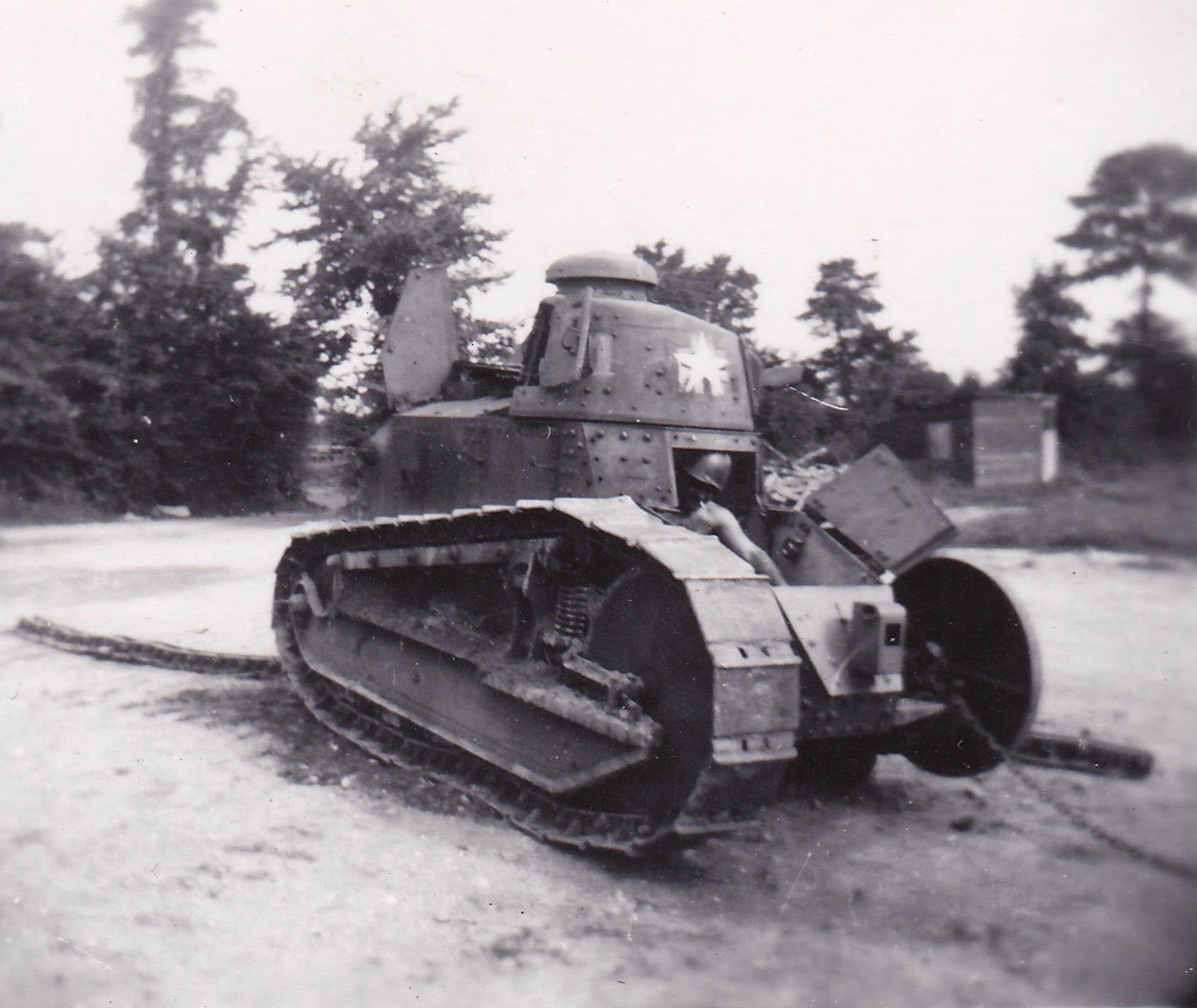
Town by town, kilometer by kilometer, Allies took back France for the French, moving eastwards. Jack, initially stationed near the Normandy landing sites, recorded in photos vestiges of the German occupation and a few scenes of French life. They would remind him of what he could not tell Alice, yet.


Tourists Derrick, Kellar, Winkler, and two others

Destroyed Renault FT tank

Storage of the kind of artillery shells that had damaged the P-51s
 
Warning about mines in French and German
French children
The Automobile-Club de l'Ouest, sponsor of the Le Mans
24-hour auto race, offered assistance to prisoners of war.
The city had been liberated in August 1944, just before Jack's visit.


France, July 15, 1944
Dearest Alice,
Honey I never did tell you about the bread we use to get in England. They do not use bleach bleached flour for there bread & it is a light brown. The first day it’s pretty good but after it gets older than a day its really terrible. All the time it’s sort of mealy and not fluffy like American. We finally got use to it but today for the first time since being over here we had real white bread. It sure was good. We were eating C & K rations over here which are hard biscuits, a small can of food sugar etc. Now we are starting to eat B rations again & it sure seems good to get potatoes, fruit etc. Today was my day off and I spent nearly all the day building a foot locker. I got it nearly done & I am pretty proud of it. I just got back from the show. The shows here on the post are free the same as they were in England. The picture was “Cover Girl.” Now I can see why you like that song Long Ago & Far Away.[3]

To see what Jack and Alice liked so much, click here

Brothers Jack and Herald reunite in France
Jack’s brother, Technical Sergeant Herald Kellar, had also moved from England to France, and Jack had the opportunity to visit him at his base.

Herald inspected downed German planes

Jack and Herald
Herald

August 1944
The end of August 1944 saw big changes for Jack and his group and for France. On the 22nd the 363rd moved down the Cherbourg Peninsula to Azeville, their second base in France.[4]

On the 25th French Resistance liberated the city of Paris from German occupation, a huge boost of morale for the French people.[5]

On the 29th the 363rd Fighter Group was converted to the 363rd Tactical Reconnaissance Group. Its role henceforth would be to photograph enemy positions and movements to help commanders make the best decisions for their troops. The 363rd's history sums up the group’s losses in the six months they were active: 103 pilots “killed as prisoners of war, evaders or due to wounds” and 104 P-51s lost and/or destroyed, either by the enemy or by accident. [6]

They were changing us at that time from a fighter to a tactical reconnaissance squadron. They put big cameras in the planes, and sent them over to take pictures of everything.  They still had their guns, so if they ran into a fight, why, they could fight. I received a new P-51D, all silver, and I had a big, red heart with Alice’s name painted on one side. My new plane did not have a fuselage tank, the gasoline tank right behind the pilot. It just had the radio on the floor. We found that we could take the canopy off, the pilot and I would both get in, the canopy was put back on, and I could take a ride with some of the pilots. I had numerous rides this way in my P-51.[7]


Jack and his A9B

Jack in the pilot's seat of his P-51

A Promotion, a Pay Raise, and a Pat on the Back
Working meant payday, and hard work brought Jack its rewards. Early in his stay in England he was promoted to Staff Sergeant, which came with a pay increase. Most of his earnings went home to Alice. Since she was living with her parents and working, Jack’s salary went toward paying off their little “cracker box” house. They were “getting ahead.” Aside from returning home to Alice safely, being on a strong financial footing was Jack’s greatest goal at this point in his life.

England, March 19, 1944
Dearest Alice,
I too was pretty proud when I made staff. My additional allotment to you will be effective the first of April instead of March. The extra money I get for March I will send you by money order.[8]

Medals and promotions were routinely bestowed on the pilots. On 12 August 1944 twelve Staff Sergeants from the 380th received letters of commendation from Colonel Tipton for their “splendid display of skill and spirit” in keeping their aircraft working. Jack’s name was at the top of the list, which included his buddies, Winkler, Derrick, and Haley.[9]

Commendation from Colonel Tipton
The next weeks and months in the European Theater of Operations surely contributed to Jack’s lifelong love of travel and “seeing the country.”


[1] “Now that we are operating from bases on the far shore, I hope all will do their utmost to continue the high standards of efficiency that have been exemplified in the past. Remember that our work is really just starting. In other words, it is all over but the fighting.” E. R. Quesada (Advanced Headquarters IX Tactical Air Command, Office of the Commanding General, APO 595, U. S. Army) letter to Colonel Tipton, 26 June 1944, excerpt, as transcribed in Nick Marinelli, The History of the 363rd Fighter Group, 380th Fighter Squadron, 381st Fighter Squadron, 382nd Fighter Squadron, 9th Air Force, ETO, IX Tactical Air Command, 70th Fighter Wing until August 1, 1944, XIX Tactical Air Command, 100th Fighter Wing until August 29, 1944, Reorganized as the 363rd Tactical Reconnaissance Group, 160th Tactical Reconnaissance Squadron, 161st Tactical Reconnaissance Squadron, 162nd Tactical Reconnaissance Squadron after September 4, 1944, and attached to the XXIX Tactical Air Command (South Lynn, Mich.: Nick Marinelli, 1992), E-2.
[2] Marinelli, The History of the 363rd Fighter Group, chapter 8, esp. 8-197, -199, -200, -201.
[3] Jack J. Kellar (France) letter to “Dearest Alice” (Alice [Streeter] Kellar), Santa Rosa, California, 15 July 1944.
[4] 380th Fighter–160th Tac. Rcn. Squadron History, February 1943–August 1945 ([unknown place]: [unknown publisher], printed by A. Roßbach, Eschwege, Germany, [1945]), 46.
[5] “Liberation of Paris,” Wikipedia (https://en.wikipedia.org/wiki/Liberation_of_Paris : accessed 22 June 2018).
[6] Marinelli, The History of the 363rd Fighter Group, 8-239.
[7] Jack J. Kellar, interview about his first years after high school by Judy Kellar Fox, 12 April 1993; cassette tape recording and transcription held by the author. Also, Jack J. Kellar, “Autobiography,” 1998; two ninety-minute cassette tape recordings; held and partially transcribed by the author. Excerpts from both interviews edited together.
[8] Jack J. Kellar (England) letter to “Dearest Alice,” 19 March 1944.
[9] 380th Fighter–160th Tac. Rcn. Squadron History, 45–6.

Saturday, June 16, 2018

26 D-Day from Above


26 D-Day from the Above
Jack in England

D-Day
Everyone knew the purpose of massing Allied strength in England was to invade France and begin pushing the Germans back to their own border. No one knew when it would happen, leaving anticipation running high all the time. Bombing and strafing missions continued from England.

A 380th armorer loads this P-51s wing gun
When the invasion finally began, the pilots from Jack’s group, the 363rd, waited all day to be called. Each of the three squadron’s pilots took turns sitting in their cockpits on rotating hour-long shifts. Finally, about nine in the evening, sixteen from the 380th took off to escort C-47 transports and gliders carrying troops behind enemy lines.[1]

Winkler's pilot Lt. Clough in "Corky-Anne II"
Lt. Huff in "Virginia Lea"

P-51 pilots, excited about confrontation with their Luftwaffe counterparts, probably found escorting C-47 transports and gliders disappointing, but their commanding officer, then-Col. James B. Tipton, described how much skill the job required.
The transports, with gliders in-tow, were strung out in a long line of ‘Vs,’ with three complements of transport plus glider making up each ‘V’ formation. Above the line of chevron-line formations, we had 50 Mustangs creating an envelope of protection for our slow friends.
The P-51 pilots had trouble flying slowly enough for their C-47s, whose average speed of 115 mph was more like the landing speed of the Mustangs, accustomed to flying at 350-400 mph.
We had to weave back and forth, even after throttling back, to keep pace with them . . . Any slower and we would be in the channel. So we had to do some exaggerated zig-zag maneuvering which had us passing under and around the line of aircraft . . . P-51s were appearing wherever you looked within our assigned cylindrical confinement. We were meeting each other head-on, pulling over, diving under and wondering where the next Mustang was coming from. Luckily, there were no enemy aircraft in the vicinity because we were so busy avoiding each other, the transports and the gliders, that I doubt that we would have noticed an enemy plane within our midst.[2]
Tipton's "Diablo"
S/Sgt. Stone, Col. Tipton, Lt. Swenson, M/Sgt. Austin
I don’t really recall all of those huge armadas crossing the Channel. I cannot visualize them, although I was right there on top of them. I don’t remember the drops . . . The only thing I remember was trying to stay with those slow-moving Gooney Birds [C-47s]. Wow! And watching for enemy aircraft which we, in the 363d, never saw.[3]
 
C-47 "Gooney Birds" troop carriers[4]
To see a C-47 pick up a glider, click here [5]

The C-47s each carried up to twenty-eight paratroopers in full combat gear. The gliders they towed each carried thirteen troops. When the gliders were released, they landed silently, placing their troops in position behind enemy lines. P-51s from Jack’s squadron escorted the C-47s and gliders that made history by dropping troops into position to retake Sainte-Mère-Église, about ten miles west of Utah Beach, one of the first towns to be liberated. Pilots watched as two of the gliders exploded on the ground. The P-51s all returned safely to base.[6]

Paratroopers in a C-47[7]
A year later Jack wrote about that historic day to Alice:
Dearest Alice,
We were near Maidstone in England and all very excited about the invasion and can you imagine here my plane was in the hangar. I was changing engines on it but it sure got a work out for a few days after.[8]

He missed the excitement of participating in D-Day altogether! Going forward, Jack kept his plane in the air providing cover for the troop carriers as the Allies pushed the Germans out of Normandy and beyond. The 363rd Fighter Group was successful, in the first weeks after the invasion, in downing nineteen German planes. The cost was the loss of about the same number of P-51s, mostly to artillery fire from the ground.[9]


A Memorable First Glimpse of France
On July first of 1944, our outfit was moving to Cherbourg, where our first base in France was to be. The biggest part of them were going by ship, but I was lucky that I was able to fly across on a C-47. They were picking up the wounded and bringing them back to England, and then they were taking men and supplies over [to France] on the C-47. We got into Cherbourg, and there was still arms and legs and stench of the dead around there. They hadn’t cleaned it up yet. It had just been taken. We got into Cherbourg, and our planes came in a few days afterwards. We got things ready for them.[10]

 The 363rd set up at Maupertus, the Cherbourg airfield liberated from the Germans at the end of June 1944. Jack was among the advance party readying the field for the arrival of their planes. By 5 July they were ready, and P-51s from his squadron, the 380th, set off at 2025 hours (8:25 p.m.) on the group’s first mission from French soil.[11]

Homer, the dog Tony Haley and I had bought in England for eight dollars, was also flown across. He was taken care of by a nurse, as they were transporting troops over and wounded back. Homer was no longer Tony Haley’s and my dog; he belonged to the 380th Fighter Squadron.[12]

380th Fighter Squadron
Homer, center, front row; Jack two men behind him

And Homer would have no trouble speaking French.


[1] Nick Marinelli, The History of the 363rd Fighter Group, 380th Fighter Squadron, 381st Fighter Squadron, 382nd Fighter Squadron, 9th Air Force, ETO, IX Tactical Air Command, 70th Fighter Wing (South Lynn, Mich.: Nick Marinelli, 1992), 6-94. Also, 380th Fighter–160th Tac. Rcn. Squadron History, February 1943–August 1945 ([unknown place]: [unknown publisher], printed by A. Roßbach, Eschwege, Germany [1945]), 6-94.
[2] Marinelli, The History of the 363rd Fighter Group, 6-95–6-96, quoting [then] Col. James B. Tipton.
[3] Judd A. Katz, U. S. Air Force Oral History Interview of Major General James B. Tipton, July 15, 1985, Auburn University, Montgomery, Alabama; digital images, The University of Alabama Libraries Digital Collections, James Tipton papers (http://purl.lib.ua.edu/122063 : downloaded 19 March 2018), 47.
[4] “Two USAAF C-47 Skytrains,” photograph, 15 August 1944, Wikimedia Commons (https://commons.wikimedia.org/wiki/File:Two_USAAF_C-47A_Skytrains.jpg : accessed 14 June 2018), public domain.
[5] “Military C-47 Picks Up Glider,” video, YouTube (https://www.youtube.com/watch?v=68O_ZHCOjwk : accessed 14 June 2018), posted 25 November 2014 by Aviation Buzzword.
[6] “C-47 Skytrain Military Transport,” Boeing (https://www.boeing.com/history/products/c-47-skytrain.page : accessed 14 June 2018), “Historical Snapshot.” Also, Michael MacRae, “The Flying Coffins of World War II” ASME [American Society of Mechanical Engineers] (https://www.asme.org/engineering-topics/articles/aerospace-defense/the-flying-coffins-of-world-war-ii : accessed 15 June 2018). Also, “Sainte-Mère-Église,” Wikipedia (https://en.wikipedia.org/wiki/Sainte-M%C3%A8re-%C3%89glise : accessed 15 June 2018). Also, 380th Fighter–160th Tac. Rcn. Squadron History, 33.
[7] “Paratroopers,” photograph, Pacific Aviation Museum (https://www.pacificaviationmuseum.org/pearl-harbor-blog/douglas-c-47dc-3-cheeky-charlie-7/ : accessed 15 June 2018), “Douglas C-47/DC3 ‘Cheeky Charlie,’” image from the Library of Congress.
[8] Jack J. Kellar to “Dearest Alice” [Alice Streeter Kellar], Santa Rosa, California, 6 June 1945.
[9]363d Expeditionary Operations Group,” Wikipedia (https://en.wikipedia.org/wiki/363d_Intelligence,_Surveillance,_and_Reconnaissance_Group : accessed 15 June 2018) > History > World War II > 363d Fighter Group.
[10] Jack J. Kellar, interview about his first years after high school by Judy Kellar Fox, 12 April 1993; cassette tape recording and transcription held by the author. Also, Jack J. Kellar, “Autobiography,” 1998; two ninety-minute cassette tape recordings; held and partially transcribed by the author. Excerpts from both interviews edited together.
[11] Nick Marinelli, The History of the 363rd Fighter Group, 7-150.
[12] Jack J. Kellar, interview 12 April 1993 and Jack J. Kellar, “Autobiography,” excerpts edited together.